Queer Places:
Villa Castello, Via Castello, 19, 80076 Capri NA
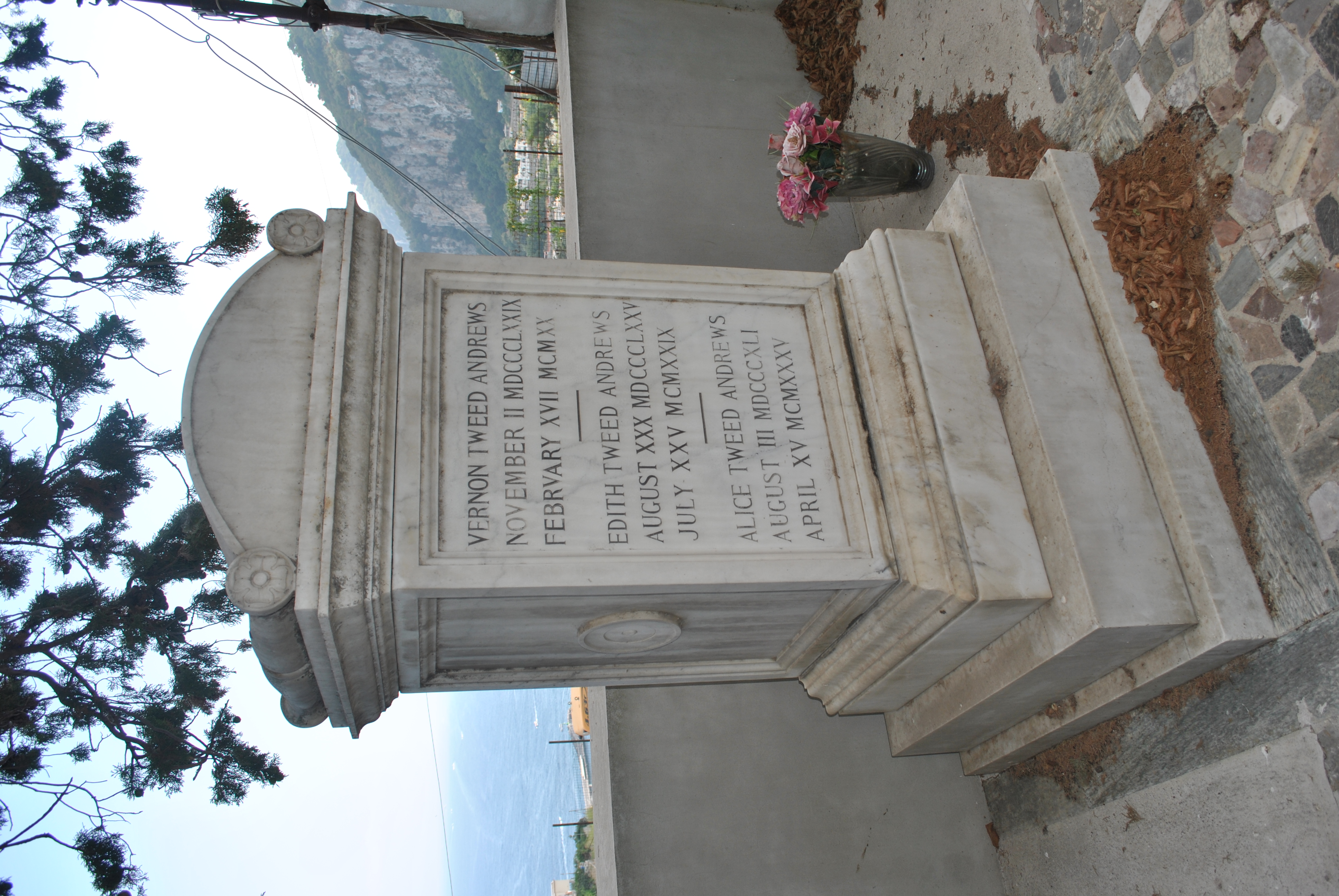
Cimitero Acattolico, Capri, Città Metropolitana di Napoli, Campania, Italy
Spring Grove Cemetery, 4521 Spring Grove Ave, Cincinnati, OH 45232, United States
Vernon Tweed Andrews (November 2, 1879 - February 27, 1920) was born on November 2, 1879, in Ohio, the son of Joseph Andrews and Alice Tweed Andrews. Following the death of his father in 1895, Vernon, his mother, and his sister Edith traveled extensively across Europe and embarked on a world tour. His cosmopolitan education was entrusted to a variety of private tutors, including a Hawaiian tutor engaged in Honolulu who taught him to dance the hula-hula. Seeking a welcoming and hospitable environment, the wealthy family arrived in Capri in 1897 when Vernon was eighteen years old. Tall, slim, good-looking, and openly homosexual, Vernon found the Mediterranean island a setting where he could live without embarrassment, earning a local reputation as an early adopter of fashionably tight trousers.
In Capri's vibrant expatriate circle, Vernon formed close friendships with literary figures like Norman Douglas and Compton Mackenzie, as well as local aesthetic personalities. In June 1909, he accompanied Douglas to Sicily and Calabria to distribute relief funds raised on Capri following the devastating Messina earthquake. During this trip, after a picnic lunch, Vernon famously drew a mysterious box from his bag and, mirror in hand, began powdering his cheeks and applying rouge to his lips, leaving their mountain muleteer entirely speechless. He also spent considerable time with the French poet Baron Jacques d'Adelswärd-Fersen, translating Fersen's French poetry and visiting his makeshift opium den, though Vernon found himself humiliated by an inability to smoke opium without becoming physically ill.
By the early 1910s, Vernon remained a central figure in the island's social and socialite scene. During the 1912 to 1913 season, the chaplain of All Saints Church, the Reverend Francis Burra, became deeply enamored with Vernon and scandalized the congregation by appointing him as his churchwarden. They spent a idyllic summer together filled with bathing, picnics, and social gatherings, though after Burra returned to London, Vernon characteristically neglected to answer his romantic letters. Following the death of scholar Thomas Spencer Jerome in 1914, Alice Tweed Andrews purchased the Villa Castello, establishing it as the family home for herself, Vernon, and Edith. During the First World War, Vernon's involvement was limited to hosting a celebration once the conflict ended, an episode immortalized alongside his personality by Compton Mackenzie, who modeled the character Nigel Dawson after Vernon in his 1927 novel Vestal Fire.
In February 1920, during the severe influenza epidemic that swept through the region, Vernon fell mortally ill at the age of forty. Maintaining a sense of composure upon being told by doctors that he had little chance of recovery, he suggested to his mother and sister that the three of them share one last bottle of champagne together. He died on February 17, 1920, in his forty-first year. He was laid to rest in the non-Catholic cemetery (Cimitero Acattolico) in Capri near fellow expatriates of his social circle, with a memorial monument also dedicated to him at Spring Grove Cemetery in his family's native Cincinnati, Ohio.
References:
 Capri: Island of Pleasure Hardcover – January 1, 1987 by James Money |
 Homintern: How Gay Culture Liberated the Modern World Paperback – November 21, 2017 by Gregory Woods |
Other references:
Support this project
This website is a passion project researched, developed, and funded entirely by me. If you find the content valuable and would like to help support the ongoing research and hosting costs, any contribution is deeply appreciated.
Thank you for keeping this independent resource alive!
My books on Amazon: Elisa Rolle's books